Comprehensive Guide to Debt Recovery Agents: Roles, Responsibilities, and Best Practices

A debt recovery agent plays a crucial role in preserving the lender- borrower relationship. Acting as an intermediary between both parties, they take the necessary steps to ensure that businesses and lenders are able to recover what they are owed while maintaining the customer relationship. Recovery agents can be defined as trained professionals who recover the unpaid debts of business and help to maintain the solvency and economic well-being of the business.
Recovery agents are the heart of the lending business as their loan collections keep the cashflow stable and preserve the financial prosperity of the business. With their expertise, businesses can easily recover debts, minimise losses and preserve their financial prosperity while maintaining ethical standards of customer communication.
Taurus Collections is a well-reputed debt and invoice collection company in India with a long track record of success in different geographies. TC assists businesses in recovery of their business debts from customers. Our trained staff excel in the collection of accounts receivables and business debts of different kinds ethically and fairly on behalf of our clients.
Definition and Responsibilities of Loan Recovery agents
Loan recovery agents excel in the recovery of unpaid business debts of different kinds. They act as the primary liaison between the business and their debtors. They communicate with the debtors, negotiate repayment terms and ensure that debts are collected in a fair and ethical manner.
The day-to day tasks of recovery agents can be broken down as
- Communicating with debtors over email, phone, and mail to remind them on overdue payments and follow up on them. They explain the debt details, including the principal, interest and penalties if any.
- Minutely examine the debtor’s financial position to gauge their ability to pay.
- Negotiating new payment plans that accommodate considering the debtor’s stressed financial situation. They propose realistic and mutually acceptable payment plans and communicate any discount and rebate details.
- Continuously monitor all communications and debtor records. They must also maintain meticulous documentation.
- Work in tandem with the legal teams when formal proceedings are launched.
Distinction between loan recovery agents and debt collectors
RBI guidelines governing the work of loan recovery agents
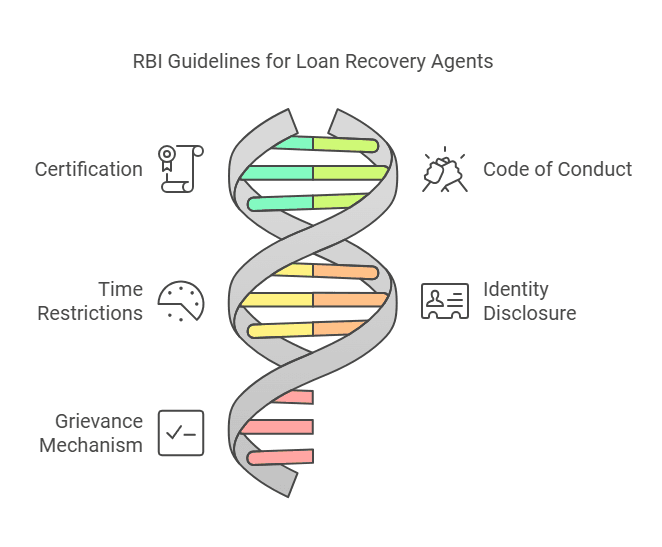
Certification
As per RBI guidelines, loan recovery agents must be properly trained and certified.
Code of Conduct
Agents must follow ethical behaviour in avoiding coercion and maintaining the borrower’s dignity
Time Restrictions
All recovery calls made to customers and borrowers must be done only between 7 a.m to 7 p.m.
Identity Disclosure
All recovery agents must provide proper identification and disclose their connection with the bank or lender.
Grievance Mechanism
All lenders must provide borrowers with a grievance redressal mechanism and address their complaints.
Other Acts like SARFAESI Act, Indian Penal Code, Consumer Protection Act all protect against unfair trade practices, mental harassment, criminal intimidation, and punishments for such behaviours.
Best Practices for ethical behaviour for loan recovery agents
- Being aware of debt collection laws and not threatening, misleading and harassing debtors
- Maintaining professional and respectful language in all communications, exercising patience even during challenging interactions.
- Transparently communicate all debt repayment details along with written agreements for any negotiated settlement.
- Use debt recovery software for debt tracking and recovery and also becoming trained in the latest technological tools
- Use ethical practices and build long term goodwill with all debtors.
Types of debt handled by debt recovery agents
- Consumer debt
- B2B debt or business debts
Challenges faced by debt recovery agents
- uncooperative and hostile debtors.
- It is a process fraught with legal risks and requires delicate and ethical handling at every stage.
- Debt recovery agents must face a negative perception from the public.
- Debt recovery agents have a tough time recovering debts during economic downturns and crises.
How loan recovery agents ensure the smooth functioning of the financial system
Every business must not only be successful in recovering their receivables but also paying their employees and creditors. Debt recovery agents play a critical role in the smooth functioning of the financial system. Their function ensures that cashflows keep flowing and there are no financial bottlenecks for the business. Mounting unpaid receivables causes financial distress and as a result, the business loses its trust among employees and creditors. Unlike big businesses that have the wherewithal to survive financial crises better, small businesses regularly infuse cashflows from their business to survive. Loan recovery agents facilitate this.
Conclusion
A debt recovery agent is an individual or an organization contracted by a creditor, including banks and credit card companies, to receive outstanding payments to the people who have taken credits. They mainly play a mediating role by approaching debtors to look into ways of paying them and settling old debts. They handle to retrieve the money due to the original creditor.
The Supreme Court and other courts in India have had it clear through court decisions that debt recovery should be carried out in a legal and ethical manner. One of the main judgements was that recovery agents were not to retrieve debts by use of force, harassment or intimidation. They should not violate the privacy and dignity of a person and act in accordance with the law because it is a civil issue rather than a criminal one.
No, a recovery agent cannot enter your house without your permission and nor is he expected to intimidate or harass you. They will typically be permitted to call you up but at a convenient time and place. Should they visit, they are supposed to conduct themselves professionally and in a respectable manner and you have a right to refuse talking to them or asking them to go away.
What you must never do is acknowledge a debt you do not believe you owe or settle such a debt since this may be considered an acknowledgement. Do not give out personal details such as your bank account numbers. Above all, make sure you are not accepting a payment plan you cannot afford since all this will end up causing stress and some debt in the future.
Yes, generally speaking, even once your debt gets sent to a collection agency you can attempt to negotiate some kind of payment plan with the original creditor on your own. A form of good practice is to write this request. The first creditor is perhaps open to cooperation with you but you need to make sure that you are clear on the fact that you are willing to pay so that the matter can be resolved within the context that will suit both of the parties.
Do Like & Share
-
 Ethical Invoice Collection: What It Means and Why It Matters for Your Client Relationships
 -
Your 5-Point Checklist Before Sending an Invoice to Collections
-
The Relationship Rescue: Recovering a Debt Without Losing the Client
-
 Not Just Cash Flow: The Hidden Business Costs of Chasing Late Payments
 -
How to Spot a High-Risk Client Before You Extend Credit?
-
"Can We Set Up a Payment Plan?" How to Handle This Client Request — and Still Get Paid
-
Why Delayed Unpaid Invoice Recoveries Are Hurting Your Business More Than You Realise?
-
New Year, Zero Dues To Recover: Business Resolution That Actually Pays Off